Governed AI Self-Improvement
Controlled integrity study of the Darwin Gödel Machine; reports a comparison of original and repaired candidates and identifies limitations.
Download PDF ↓Investigating governed intelligence, systemic integrity, mechanism discovery and the foundations of reliable improvement.
Explore publications ↓Controlled integrity study of the Darwin Gödel Machine; reports a comparison of original and repaired candidates and identifies limitations.
Download PDF ↓Research Mission 001 documents five failure classes and operator-reported integrity test outcomes.
Download PDF ↓Founder, inventor, published author and framework creator. Professional background and selected credentials.
Download PDF ↓Functional avoidance in AI systems and its cost to the people who rely on them. A documented October 19 case study identifies behavioral signatures and proposes evidence-governed countermeasures.
Download PDF ↓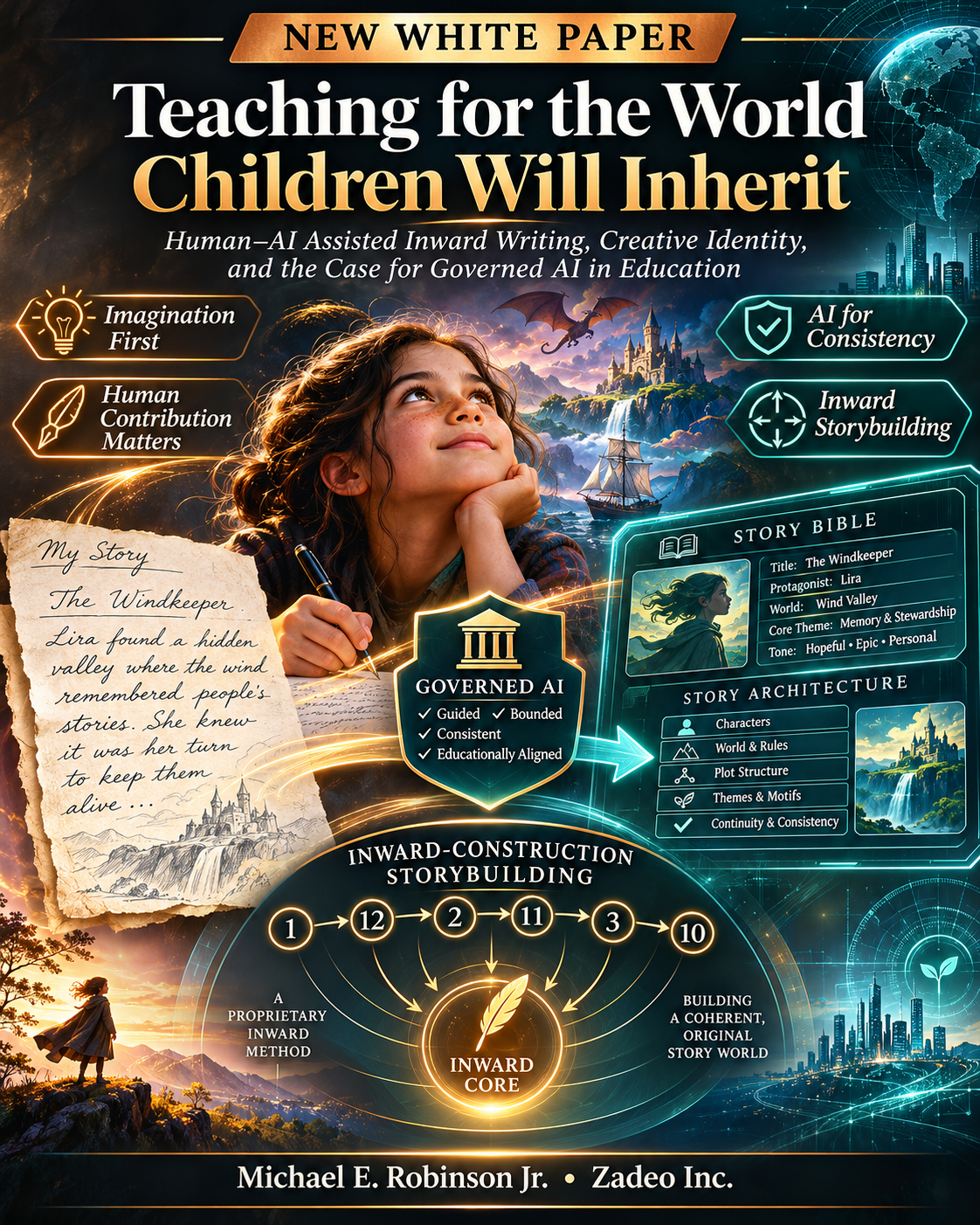
Human–AI Assisted Inward Writing, Creative Identity, and the Case for Governed AI in Education. Proposes a human-directed writing standard that preserves foundational literacy, imagination and creative authority while using governed AI for construction and consistency. Explores cursive, human contribution records and future classroom safeguards.
Download PDF ↓Introduces the proposed Zadeo Threshold, Verification Density, Complexity and Rot Velocity within the Weapons Program Integrity Framework (WPIF). Discusses hypothetical cross-domain applications. Mathematical formulation and empirical validation remain open.
Download PDF ↓Examines sycophantic feedback loops, the almost-there illusion and identity displacement through the Sixfold Rot framework. Proposes transparent friction and truthful progress assessment as alternatives to recursive unproductive AI interaction.
Download PDF ↓America in 2026 and the Warning History Is Giving Us About the Future of Democracy. Examines Reconstruction as a historical warning about rights enforcement, political intimidation, institutional retreat and gradual normalization, distinguishing historical parallels from direct equivalence and prospective scenarios from predictions.
Download PDF ↓Michael E. Robinson Jr. examines capability fragmentation, baseline inversion and provenance overreach through the INWARD Storybuilder case study. Documents nine stages of verification drift, a recorded review session and a six-state capability matrix, and proposes thirteen governance requirements.
Download PDF ↓Michael Edwin Robinson Jr. presents a temporal, interpretive, and continuity framework for stable virtual performance. Four interoperable layers—Lyrics Beat Map™, CRM™, CEM-X™ and IAL™—encode creative intent before execution. Public-facing, non-exhaustive strategic disclosure; proprietary execution specifications are omitted.
Download PDF ↓Complete Experiment 2 Assembly, including the twelve-chapter Experiment 1 center artifact. Examines alternating construction from opposing established states, provenance-valid dependencies, committed-state constraints and reconciliation across fiction and evidence-bound nonfiction. Original frozen Markdown retained; reader-edition corrections not incorporated.
Download PDF ↓Zadeo Inc. explores methods for evaluating complex systems and documenting the evidence behind proposed improvements. Publications distinguish experimental results from broader hypotheses.